
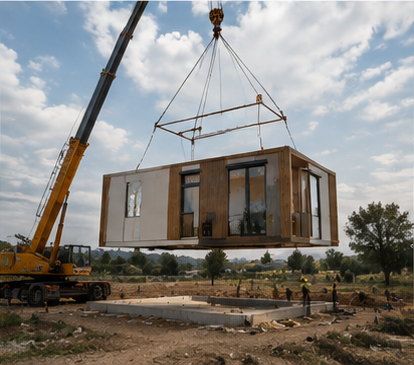
Imagine finding the home you want, choosing the design, and knowing that most of the construction is completed before the house even reaches your land.
That is the main idea behind modular construction.
Instead of building everything outdoors, piece by piece, a modular home is manufactured in a controlled factory environment. The structure, insulation, walls, electrical systems, plumbing, flooring, kitchen and bathroom can be prepared before the home is transported to its final location.
But if you are considering buying a modular home from another country, you probably have a more important question:
Why Turkey?
Why Are More Modular Homes Being Manufactured in Turkey?
Turkey has become an attractive manufacturing location because it sits between Europe, Asia and the Middle East. For European customers, this geographical position is particularly important.
A modular home is not a small product that can simply be put in a parcel. It is a building that has to be transported by truck, ship or both. Being relatively close to Europe means shorter transportation routes and easier logistics compared with manufacturing in distant markets.
But location is only one part of the story.
Turkey already has a large construction and manufacturing industry. Steel, insulation, windows, doors, electrical products, bathroom equipment, kitchens and many other building components can be sourced through an established local supply chain.
There is also a large pool of experienced architects, engineers, steel workers, welders and construction professionals.
The result is an interesting combination: European markets are relatively close, while manufacturing and skilled labor remain competitive.
For a customer, this can mean getting a professionally manufactured home without paying the same manufacturing costs that may apply in Western Europe.
But then comes the question most buyers ask:
What does the manufacturing process actually look like?
From a Drawing to Your Home
Everything starts with the design.
Before production begins, the manufacturer needs to understand where the house will be installed, how large it will be, what climate it will face and how it will be transported.
This is important because a modular home has to be designed for two things: living and transportation.
Once the design and engineering are approved, production begins.
The structural steel frame is manufactured first. Insulation and wall systems are then installed, followed by windows, doors, roofing and exterior finishes. Electrical and plumbing systems are prepared, while the interior is completed with flooring, kitchen, bathroom and other selected finishes.
One of the biggest advantages is that much of this work happens inside the factory.
There is no dependence on rain, mud or changing site conditions for every stage of construction. Production can be organized systematically, and the manufacturer can inspect the home before it leaves the factory.
Then comes the exciting part.
Your house leaves Turkey.
How Does a Modular Home Travel from Turkey to Europe?
The transportation method depends on the size and design of the house.
Some modular homes are designed to be transported as complete modules. Others are produced in sections or packed efficiently for container or truck transportation.
The journey may look something like this:
Factory → Truck → Port → Ship → Destination → Truck → Your Land
Before production, the manufacturer should calculate the transportation dimensions, weight, loading method and unloading requirements.
This is something you should ask about before ordering—not after the house is finished.
You should also ask whether transportation, unloading and installation are included in the quotation.
Because the price of the house is only one part of the project.
What About the Foundation?
A modular home still needs a properly prepared foundation.
The exact solution depends on the house, soil conditions and local regulations. Depending on the project, this could be a concrete slab, concrete pads, strip foundations or another engineered solution.
The important point is that a modular home is not simply placed on the ground.
The foundation needs to be level, structurally suitable and prepared for the connections between the building and the ground.
A professional manufacturer should provide the necessary foundation and structural information so that the local contractor or engineer can prepare the site correctly.
And this brings us to perhaps the most important question for an international buyer.
Can You Legally Put a Modular Home on Your Land?
The answer depends on the country and the specific property.
Being “modular” does not automatically mean that a building is exempt from planning or building regulations.
If you want to use the house as a permanent residence, your local municipality may require planning permission, building approval, structural calculations or other documentation.
This is why you should check the regulations before purchasing the house.
Your manufacturer can prepare architectural and technical documentation, but local approval is normally determined by the authorities in the country where the house will be installed.
A good manufacturer should be able to work with your local architect or engineer rather than simply delivering a house and leaving you to solve everything yourself.
And What Happens When the House Arrives?
This is another question worth asking before signing a contract.
Who unloads the modules?
– Is a crane required?
– Who assembles the house?
– Who connects the electricity and water?
– How long does installation take?
These details can make a big difference to the final project cost and timeline.
With a properly planned modular project, most of the difficult work has already been completed at the factory. Once the prepared foundation is ready, the modules can be positioned, connected and finished on site.
For larger projects, such as glamping resorts, holiday villages or multiple rental homes, this can be particularly valuable because several units can be manufactured while site preparation is happening at the same time.
Is a Modular Home Really a “Real House”?
This is probably the question behind all the other questions.
Yes—when it is properly engineered and manufactured.
A modular home is not defined by being temporary or low quality. Its performance depends on the structural system, insulation, waterproofing, windows, roof, materials and engineering.
A well-designed modular home can be built for permanent living, holiday use, rental properties, glamping, hospitality and other applications.
The key is not simply asking:
“Is it modular?”
Ask instead:
“How is it engineered, what materials are used, what is included, and how will it be installed on my land?
So, Is Turkey the Right Place to Buy Your Modular Home?
For many international buyers, Turkey offers a compelling combination of location, manufacturing experience, skilled manpower and a strong construction supply chain.
But choosing the country is only the beginning.
The real decision is choosing a manufacturer that can take responsibility for the entire journey—from design and engineering to manufacturing,
transportation and installation.
Because when you buy a modular home from another country, you are not simply buying walls and a roof.
You are buying a process.
And the better that process is planned, the easier your journey from “I want a modular home” to “Welcome home” will be.